By Biswajit Mondal from Shyamnagar, Satkhira
Jelekhali, a village in Munshiganj Union of Satkhira’s Shyamnagar Upazila, is known for its agricultural heritage yet struggles with continuous environmental challenges. Salinity intrusion through canals, waterlogging, and drought regularly threaten the agriculture of the area. Despite these hardships, local farmers are striving to sustain biodiversity through their innovative and creative practices. Loknath Mondal is among those farmers who has established an Agroecology Learning Center a home to contribute to enriching and restoring biodiversity.
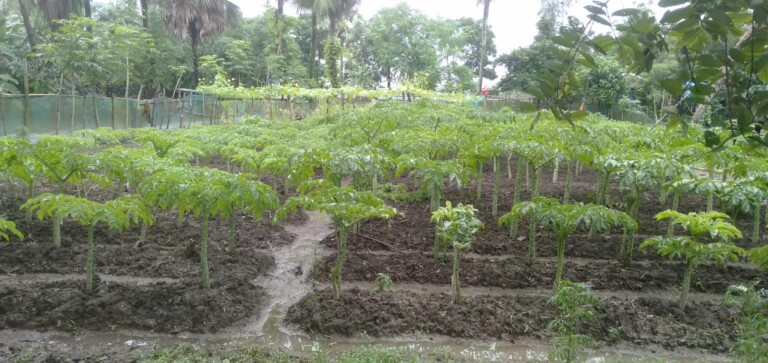
Loknath Mondal has 10 bighas of land where cultivates rice in 6 bighas and the rest 4 bighas is his homestead, where he grows a diverse crops year-round. His homestead has mango, black plum, palmyra palm, water apple, lemon, jujube, elephant apple, custard apple, wood apple, coconut, pomegranate, hog plum, sapodilla, guava, banana, and papaya. He has timber species like mahogany, tamarind, rain tree, persimmon, haritaki, and bamboo.
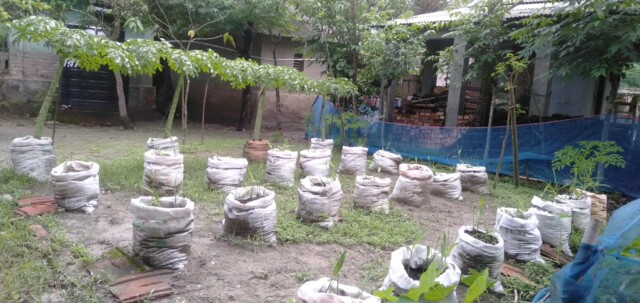
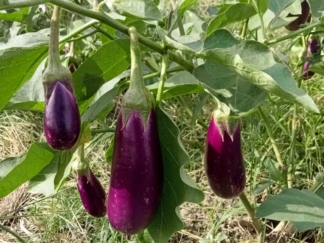
He grows yam, taro, okra, long bean, pumpkin, bottle gourd, eggplant, Malabar spinach, ash gourd, cucumber, bitter gourd, ridge gourd, turmeric, ginger, and chili vegetables that meet his family needs and earns cash selling the surplus. He also cultivates traditional rice varieties such as Chinikani, Patnai, Swarna and Mashuri, conserving seeds himself for future planting.
He also conserves uncultivated plants such as thankuni (centella), boutuni, adabrun, black taro, water spinach, helencha, bryophyllum, and ghumshak. His ponds and canals teem with native fish such as shol, koi, puti, lata, chang, tilapia, crab, and various carp species.
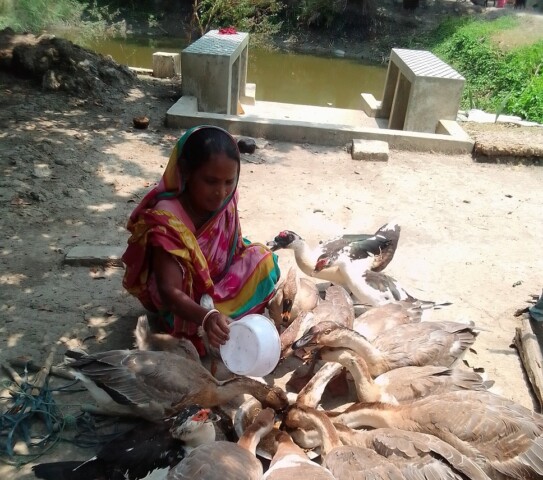
In order to meet his family’s nutrition needs he rears livestock such as cows, goats, native geese, meri ducks, and chickens. These livestock helps him generating nutrition for his family members.
 Exif_JPEG_420
While sharing his experience Loknath said, “I come from a farming family. I’ve been doing this since childhood. But our area faces frequent disasters that is why we need to adopt new techniques. Through my sister, I got introduced to BARCIK, whose advice inspired me to embrace agroecological practices. Visiting agroecology learning centers in Dhumghat, Mathurapur, Pankhali, and Srifalkati with BARCIK’s help expanded my vision.”
He went on saying: “Now I use trellising, mulching, tower and sack cultivation for ginger and yam, grow crops in old pots, bottles, and plastic bags, and make vermicompost and pit compost. I plant marigolds to control pests naturally.”
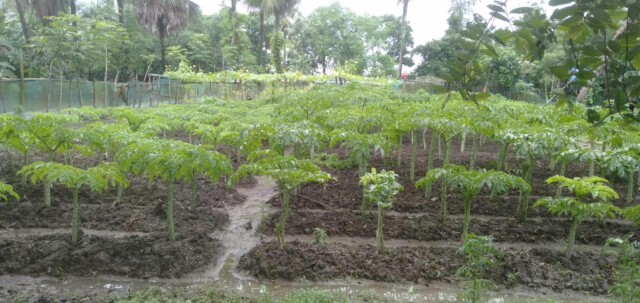
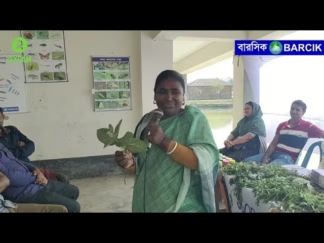
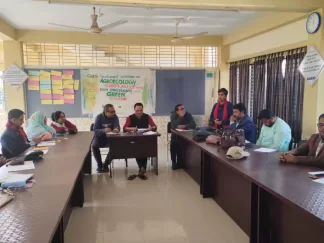
Loknath mentioned that BARCIK has identified his homestead as an agroecology learning center and is providing support and training to ensure the growth of the center. he said, “Every month we have meetings and workshops here. I also preserves traditional tools like plows, yokes, harrows, grain bins, and clay pots. Every year people from my and other villages buy ginger, turmeric, taro, and Chinikani rice seed from me. I plan to form a farmers’ group here. My dream is to turn this place into a vibrant school of biodiversity.”
Despite the coastal region’s vulnerability to disasters and salinity that threaten biodiversity, Loknath Mondal’s efforts prove that with commitment and innovation, conserving and restoring agro-biodiversity is possible.