By Mofijur Rahaman, from Shyamnagar, Satkhira
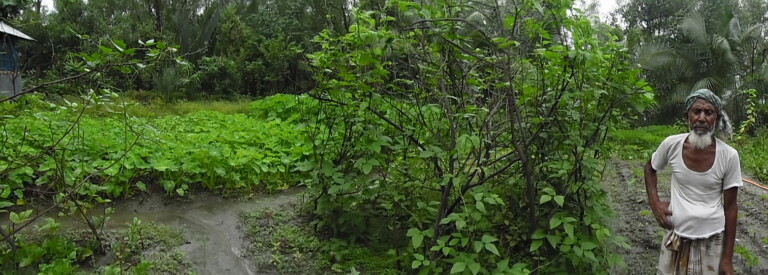
The coastal region of Bangladesh is one of the most challenging areas for agriculture due to salinity, natural disasters, and climate change. In this difficult context, 70-year-old farmer Naosher Ali Sana of Bonnyatala village in Shyamnagar’s Padmapukur Union has become a symbol of resilience. He has transformed his homestead into a learning center for agroecology since 2024.
Having grown up in a farming family, Naosher Ali gained hands-on experience from childhood. He learned the technique to plow fields, plant crops, and fish in rivers. Over the years, he has witnessed how saline water intrusion, irregular rainfall, and shrimp farming have degraded soil fertility and biodiversity.
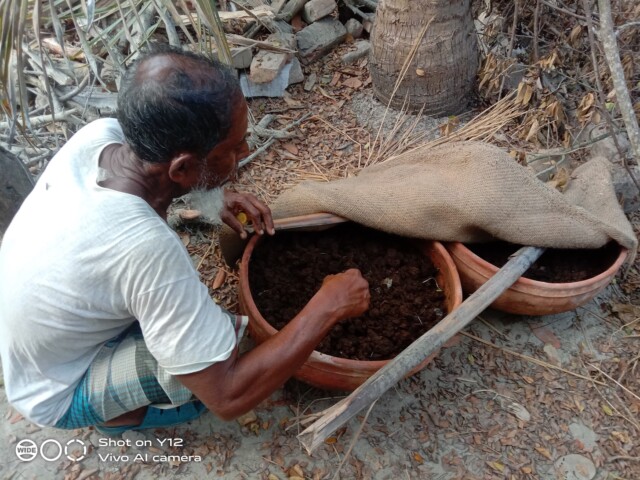
Naosher Ali said, “Excessive use of chemical fertilizers has ruined the soil. Just like human health, soil health must be protected. Farming should be treated like nurturing a child.” In order to address this, he practices agroecology, using compost and avoiding chemicals.
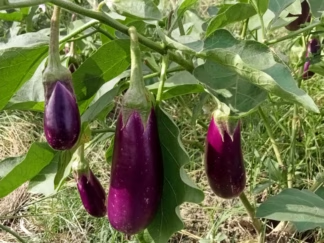
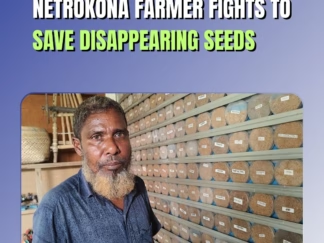
Naosher’s homestead now produces a variety of vegetables such as okra, tomato, red amaranth, and taro), fruits (mango, guava, pomegranate, date), and trees (neem, mahogany, sundari, gewa). He also conserves and distributes seeds among other farmers. In this monsoon, he supported 17 neighbors with seeds of sponge gourd, okra, and bottle gourd, reducing market dependence and enhancing food security.
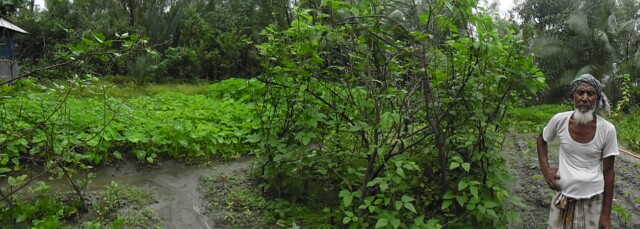
He leases four bighas of land for rice cultivation, which meets his family’s yearly rice needs. His surplus vegetables and keora fruits provide extra income. He also rears livestock to meet nutrition demand of his family.
Today, Naosher Ali Sana is seen as a local farming advisor. “Without farmer-led control, agriculture cannot survive,” he said. He went on saying, “If we do not value farmers’ knowledge and decisions, we will become dependent on others.”
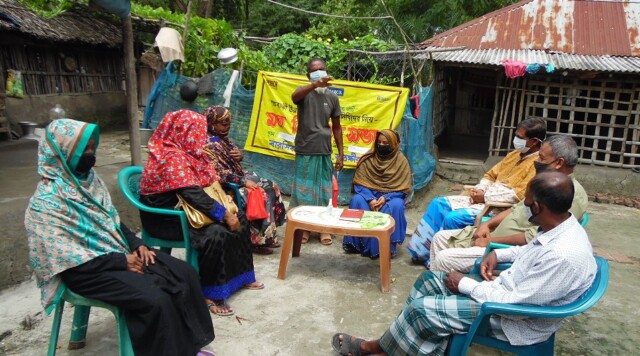
Naosher Ali Sana stands as a powerful example of how farmers in coastal Bangladesh are protecting agriculture against adversity through adopting agroecology. His organic methods, seed-conserving efforts, biodiversity conservation, and community knowledge-sharing benefit not just his family, but the wider area.