By Shimul Biswas, from Singair, Manikganj
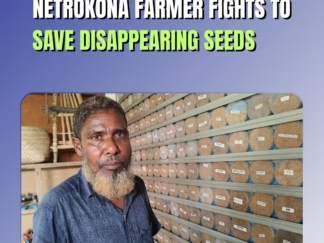
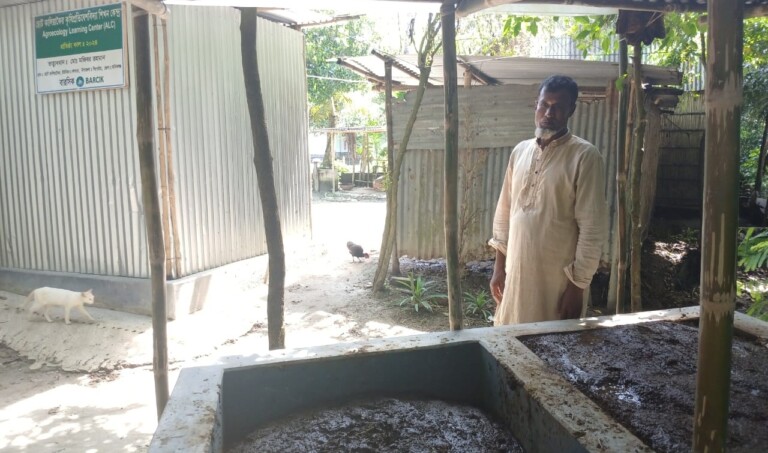
In the village of Chhoto Kaliakoir under Singair upazila of Manikganj district, 56 year old farmer Mojibur Rahman has established an Agroecology Learning Center (ALC) along with a seed bank for local crop varieties. This initiative is showing farmers new ways to practice environment-friendly and cost-effective farming. With support from the BARCIK, the center is being considered a model for sustainable agriculture, food security, and environmental conservation.
The majority of households in Chhoto Kaliakoir depend on agriculture, mainly cultivating rice and vegetables. However, due to modern agricultural practices and the scarcity of diverse local seeds, production costs are rising while profits are declining. The reduction of native rice and vegetable varieties has further worsened this challenge. In order to address these issues, Mojibur Rahman founded the learning center in 2024 for local farmers.
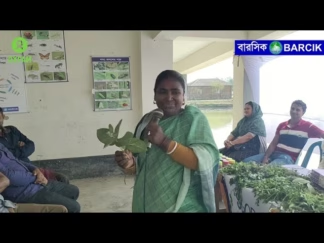
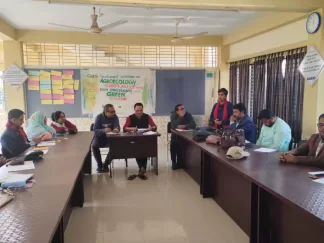
The center provides farmers with regular practical training, demonstration plots, advisory services, and seed conservation activities. Every month, 20–30 farmers come here to learn eco-friendly farming techniques, seed conservation methods, and compost use.
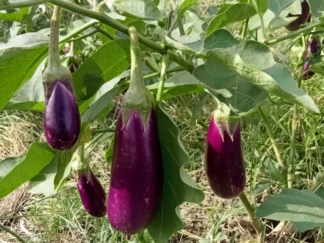
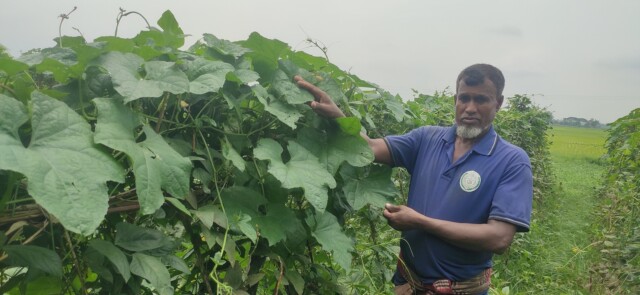
This year, on his own two-bigha demonstration plot, Mojibur Rahman cultivated five varieties of rice, eighteen varieties of vegetables, three types of oil crops, along with garlic, onion, chili, wheat, barley, ginger, turmeric, and potatoes. The yields were highly promising, and he conserved quality seeds from the harvest. Presently, his seed bank holds 10 varieties of rice, 20 varieties of vegetables, three types of oil crops, and altogether 41 types of diverse native seeds including garlic, onion, ginger, turmeric, barley, and chili.
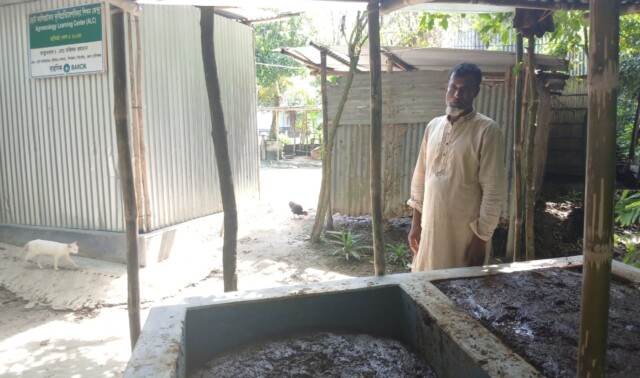
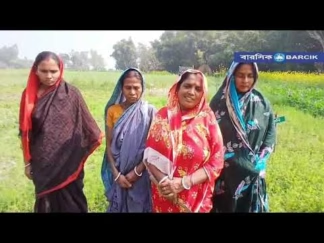
Mojibur Rahman’s initiative has already created visible impacts in the lives of local farmers. Most of those who visited the center and received training have been benefited as they now produce higher crop yields than before. Through seed conservation and sustainable farming practices, farmers are saving an average of 15–20% in production costs each year. Moreover, 60% of them have reduced the use of chemical fertilizers and pesticides, contributing to environmental conservation.
Although still at an early stage, many farmers are yet to fully adapt to the new methods. Natural disasters and uncertain rainfall have also posed some challenges for its activities.
Mojibur Rahman said, “In the coming days, this training center will be further enriched so that farmers can practically learn and practice eco-friendly agriculture.” He also mentioned that he has a plan to create a seed database, expand community-based agricultural support, and promote the wider use of organic fertilizers.
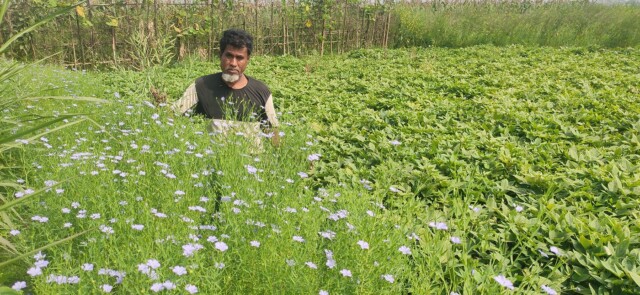
Though newly established, the learning center is already inspiring local farmers to adopt agroecological practices and seed conservation. In the future, it has the potential to evolve into a full-fledged learning center that will play a vital role in improving farmers’ livelihoods and ensuring food security.